One-Stop ODF Solution for Serious Brands
Author: Sihan Meng, Leyu Zhu, Pengcheng Shi
Affiliation: RSBM
Email: pengchengshi@biotechrs.com; pcspc9@gmail.com
Abstract
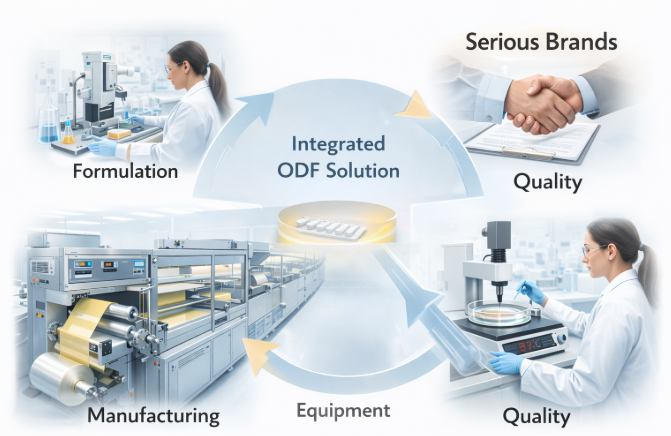
As oral dissolving films (ODFs) mature into a mainstream delivery format, brand owners increasingly require integrated solutions that extend beyond formulation alone. Fragmented development—separating formulation, equipment, manufacturing, and quality systems—often leads to scale-up failure, delayed launches, and inconsistent product performance. This paper presents a one-stop ODF solution model designed for serious brands seeking reliability, speed, and global scalability. By unifying formulation design, equipment engineering, GMP manufacturing, and quality assurance within a single framework, this approach reduces technical risk, accelerates commercialization, and ensures long-term supply stability.
Introduction
The rapid adoption of ODFs across nutraceutical, nicotine, and functional consumer health categories has exposed structural weaknesses in traditional outsourcing models. Brands commonly rely on multiple vendors for formulation, pilot production, commercial manufacturing, and packaging, resulting in misaligned specifications and limited accountability [1,2]. Serious brands—defined here as those prioritizing long-term market presence, regulatory readiness, and scalable supply—require an integrated solution that aligns technical development with manufacturing realities from the outset. This paper examines the rationale, structure, and outcomes of a one-stop ODF solution model.
Methods
Integrated Development Framework
The one-stop model begins with application-driven formulation design, incorporating target onset time, mechanical properties, packaging compatibility, and regulatory positioning. Equipment constraints and line-speed requirements are considered concurrently to avoid downstream incompatibility [3].
Equipment–Process Co-Design
ODF machines are configured or engineered to match formulation rheology, drying behavior, and target throughput. This co-design approach ensures that laboratory and pilot results are transferable to commercial-scale production [4].
GMP Manufacturing and Quality Alignment
Manufacturing is conducted within GMP-aligned facilities using standardized operating procedures. Quality systems, including in-process controls and documentation, are embedded early to support regulatory audits and global supply [5].
Measures
Development Efficiency
Time from concept to pilot-scale validation and to commercial readiness was measured to assess development acceleration compared with fragmented models [6].
Product Consistency
Critical quality attributes—film thickness, content uniformity, disintegration time, and mechanical strength—were evaluated across development stages and production scales [7].
Supply Reliability
Batch success rate, deviation frequency, and scalability across production lines were tracked to assess operational robustness [8].
Results
The one-stop ODF solution demonstrated significantly reduced development timelines and fewer scale-up failures. Product specifications remained consistent from pilot to commercial production, with minimal reformulation required. Integrated accountability improved communication efficiency and reduced corrective actions during validation. Brands adopting this model achieved faster market entry and more predictable supply performance.
Discussion
Serious brands benefit from shifting their focus from transactional outsourcing to strategic integration. The one-stop model mitigates common risks associated with ODF commercialization, including formulation–equipment mismatch and late-stage compliance issues. While initial engagement may require deeper collaboration, the long-term advantages in speed, quality, and scalability outweigh the perceived loss of flexibility. This approach is particularly suited to brands aiming for international expansion and differentiated product positioning [9].
Conclusion
A one-stop ODF solution provides a robust pathway for serious brands to develop, scale, and supply oral dissolving film products with confidence. By integrating formulation, equipment, manufacturing, and quality systems into a unified framework, this model reduces technical risk, accelerates commercialization, and supports sustainable global growth. As ODF markets continue to evolve, such integrated solutions are likely to become the standard for high-performing brands.
References
Dixit RP, Puthli SP. Oral strip technology: Overview and future potential. J Control Release. 2009;139(2):94–107.
Borges AF et al. Oral films: Current status and future perspectives. J Control Release. 2015;206:1–19.
Preis M, Breitkreutz J. Manufacturing and formulation considerations for oral films. Expert Opin Drug Deliv. 2017;14(6):1–12.
Hoffmann EM et al. Manufacturing of orodispersible films: From lab scale to production. Eur J Pharm Biopharm. 2011;78(3):447–455.
World Health Organization. WHO guidelines on good manufacturing practices (GMP).
Montgomery DC. Introduction to Statistical Quality Control. Wiley.
Cilurzo F et al. Fast dissolving films: Mechanical and technological properties. Eur J Pharm Biopharm. 2008;70(3):895–900.
ICH Q8(R2). Pharmaceutical Development.
Morales JO, McConville JT. Manufacture and characterization of oral films. Eur J Pharm Biopharm. 2011;77(2):187–199.
Previous:The Best ODF Solution — From Formula to Line
Next:No Information