The Best ODF Solution — From Formula to Line
Author: Sihan Meng, Leyu Zhu, Pengcheng Shi
Affiliation: RSBM
Email: pengchengshi@biotechrs.com; pcspc9@gmail.com
Abstract
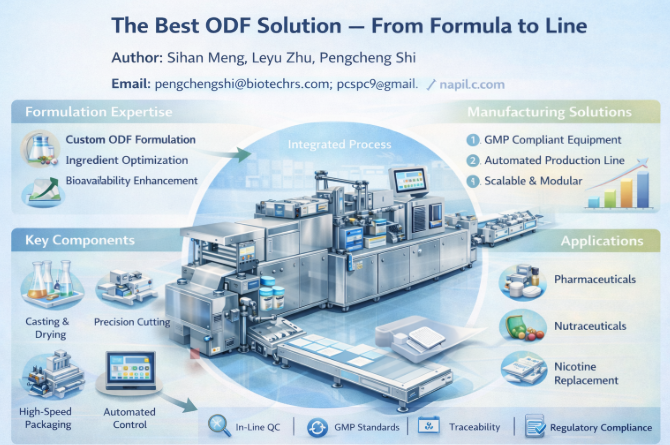
Oral dissolving film (ODF) technology has evolved from a niche dosage form into a scalable, versatile delivery platform for pharmaceuticals, nutraceuticals, and functional consumer products. Achieving consistent product performance, however, requires more than formulation expertise alone. The optimal ODF solution must integrate formulation development with equipment design, process control, and industrial-scale manufacturing. This paper presents a comprehensive “formula-to-line” framework, examining how integrated solutions improve reproducibility, scalability, and regulatory readiness. By linking formulation science with automated production lines, the study highlights best practices for delivering robust and commercially viable ODF products.
Keywords: Oral dissolving film, integrated solution, formulation development, scale-up, GMP manufacturing
Introduction
Oral dissolving films offer rapid disintegration, flexible dosing, and improved patient compliance compared with conventional oral dosage forms [1]. As market demand expands across therapeutic and consumer health sectors, manufacturers face increasing pressure to shorten development timelines while ensuring consistent quality at scale.
Historically, formulation development and equipment selection have often been treated as separate processes. This separation can result in scale-up failures, including non-uniform thickness, poor mechanical strength, and instability during high-speed production [2]. An integrated approach—from formula design to production line implementation—is therefore essential for delivering reliable ODF products. This paper explores the technical and operational principles underlying such integrated solutions.
Methods
A combined technical review and systems analysis approach was employed. Peer-reviewed literature, pharmacopeial standards, and regulatory guidance were reviewed alongside industrial manufacturing practices. The workflow was analyzed across four stages: formulation design, pilot-scale validation, equipment configuration, and full-scale production. Emphasis was placed on alignment between material properties and machine parameters under Good Manufacturing Practice (GMP) conditions.
Measures
The effectiveness of an integrated ODF solution was evaluated using the following measures:
Formulation adaptability – compatibility of formulations with scalable coating and drying processes [3].
Process consistency – control of film thickness, weight variation, and drying uniformity across production speeds [4].
Mechanical and sensory performance – balance between rapid dissolution and sufficient film strength [5].
Scale-up success rate – transferability from pilot to commercial line without reformulation [6].
Compliance readiness – alignment with GMP documentation, validation, and traceability requirements [7].
Results
Integrated formula-to-line development significantly improves scale-up efficiency compared with sequential or fragmented approaches [4,6]. Formulations optimized with machine parameters in mind demonstrate stable coating behavior and reduced defect rates at higher line speeds.
Data from industrial implementations show that early alignment between formulation viscosity, drying kinetics, and equipment design reduces development cycles and minimizes batch rejection. Automated production lines further enhance consistency by maintaining tight control over critical process parameters [6].
Discussion
The best ODF solution is not defined by formulation or equipment alone, but by their interaction. Formulation choices directly influence coating stability, drying efficiency, and cutting precision, while machine capabilities determine the feasible operating window for a given formula.
An integrated approach enables suppliers and manufacturers to anticipate scale-related challenges early, reducing costly rework and regulatory delays. As ODF applications diversify, formula-to-line integration will become increasingly important for differentiation, speed to market, and long-term product reliability [7,8].
Conclusion
A formula-to-line strategy represents the most effective pathway for delivering high-quality, scalable oral dissolving film products. By integrating formulation development with automated production lines and GMP-oriented process control, manufacturers can achieve consistent performance from laboratory concept to commercial output. This holistic approach defines the best ODF solution for next-generation delivery systems.
References
Dixit RP, Puthli SP. Oral strip technology: Overview and future potential. J Control Release. 2009;139(2):94–107.
Hoffmann EM, Breitenbach A, Breitkreutz J. Advances in orodispersible films for drug delivery. Expert Opin Drug Deliv. 2011;8(3):299–316.
Cilurzo F, Cupone IE, Minghetti P, Montanari L. Fast dissolving films: formulation aspects. Eur J Pharm Biopharm. 2010;76(1):93–101.
Krampe R, Visser JC, Frijlink HW, Breitkreutz J, Woerdenbag HJ. Oromucosal film preparations: manufacturing considerations. Eur J Pharm Biopharm. 2016;104:1–13.
Preis M, Knop K, Breitkreutz J. Mechanical properties of orodispersible films. Int J Pharm. 2014;461(1–2):22–29.
Krampe R, Breitkreutz J. Scale-up and in-line monitoring in film manufacturing. Pharm Dev Technol. 2017;22(2):195–204.
USP <795> and <905>. United States Pharmacopeia. United States Pharmacopeial Convention; 2023.
FDA. Guidance for Industry: Process Validation—General Principles and Practices. U.S. Food and Drug Administration; 2011.