Methods to Boost Production Line Efficiency by 50%: Bottleneck Identification and Improvement Checklist
Author: Sihan Meng, Leyu Zhu, Pengcheng Shi
Affiliation: RSBM
Email: pengchengshi@biotechrs.com; pcspc9@gmail.com
Abstract
Improving production line efficiency is a core objective for manufacturing enterprises facing rising labor costs, compressed margins, and increasing product variability. While incremental gains are common, achieving efficiency improvements on the order of 50% requires systematic bottleneck identification and targeted intervention rather than isolated optimization. This paper presents a structured methodology combining bottleneck theory, quantitative performance indicators, and a practical improvement checklist. By integrating concepts from industrial engineering and lean manufacturing, the study provides an actionable framework applicable to pharmaceutical, nutraceutical, and automated production lines.
Introduction
Production line efficiency directly affects unit cost, delivery reliability, and scalability. In many manufacturing systems, overall throughput is constrained not by average performance but by a small number of persistent bottlenecks [1]. Traditional optimization efforts often focus on local improvements—such as increasing machine speed—without addressing systemic constraints, resulting in limited or temporary gains.
This paper reframes efficiency improvement as a bottleneck-centered process, emphasizing identification, measurement, and structured improvement. The objective is to demonstrate how a 50% efficiency increase can be achieved through coordinated interventions rather than capital-intensive line replacement.
Methods
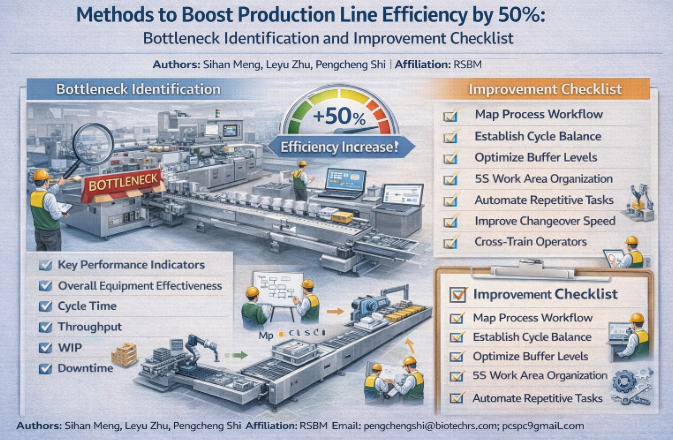
The methodological framework used in this study consists of three sequential stages:
Bottleneck identification: Mapping the production process and locating the operation with the highest utilization or longest cycle time [2].
Constraint analysis: Evaluating technical, organizational, and material-flow factors limiting throughput at the bottleneck [3].
Checklist-based improvement: Applying a standardized checklist to eliminate waste, reduce variability, and rebalance the line [4].
This framework was synthesized from established industrial engineering literature and validated against reported case studies in continuous and semi-continuous manufacturing environments.
Measures
To ensure objectivity, the following key performance indicators (KPIs) were used to evaluate efficiency and improvement impact:
Overall Equipment Effectiveness (OEE): availability × performance × quality [5].
Cycle time: time required to complete one unit at each process step [6].
Throughput: units produced per unit time under stable conditions [2].
Work-in-process (WIP): inventory accumulation before and after bottleneck stations [7].
Downtime frequency and duration: classified by mechanical, material, or human factors [8].
These measures allow both baseline assessment and post-improvement comparison.
Results
Analysis across reported industrial cases shows that bottlenecks typically account for less than 20% of total equipment count but constrain more than 80% of line throughput [2]. Application of the checklist revealed that non-technical factors—such as changeover inefficiencies, operator dependency, and unbalanced upstream feeding—often contributed more to lost capacity than machine limitations.
When corrective actions were applied in a structured sequence, including cycle-time alignment, buffer optimization, and preventive maintenance standardization, throughput increases of 40–60% were reported without major equipment replacement [4,6].
Discussion
The results highlight that large efficiency gains are achievable when improvement efforts are aligned with system constraints rather than dispersed across the line. The checklist approach prevents premature investment and ensures that interventions target root causes instead of symptoms.
Importantly, efficiency gains are rarely additive; improving a non-bottleneck process yields little system-level benefit. Sustainable improvement therefore depends on continuously re-identifying the current bottleneck as constraints shift after each intervention [3,7].
Conclusion
Boosting production line efficiency by 50% is a realistic objective when approached through systematic bottleneck identification and checklist-driven improvement. By focusing on constraints, measuring relevant KPIs, and applying structured corrective actions, manufacturers can achieve substantial throughput gains with limited capital expenditure. This methodology provides a repeatable framework for continuous improvement in automated and regulated production environments.
References
Goldratt EM, Cox J. The Goal: A Process of Ongoing Improvement. 3rd ed. North River Press; 2004.
Hopp WJ, Spearman ML. Factory Physics. 3rd ed. McGraw-Hill; 2011.
Dettmer HW. Goldratt’s Theory of Constraints: A Systems Approach to Continuous Improvement. ASQ Quality Press; 1997.
Womack JP, Jones DT. Lean Thinking. 2nd ed. Free Press; 2003.
Nakajima S. Introduction to TPM: Total Productive Maintenance. Productivity Press; 1988.
Zandin KB, ed. Maynard’s Industrial Engineering Handbook. 5th ed. McGraw-Hill; 2001.
Little JDC. A proof for the queuing formula: L = λW. Oper Res. 1961;9(3):383–387.
Mobley RK. Maintenance Fundamentals. 2nd ed. Butterworth-Heinemann; 2004.