New Product Launch Acceleration Package: How We Achieve 7–14 Day Sample Delivery
Author: Sihan Meng, Leyu Zhu, Pengcheng Shi
Affiliation: RSBM
Email: pengchengshi@biotechrs.com; pcspc9@gmail.com
Abstract
Speed-to-sample has become a decisive competitive factor in Oral Disintegrating Film (ODF) and functional oral product markets. While many OEM/ODM suppliers claim rapid sampling, only a minority can consistently deliver qualified, scalable samples within 7–14 days without compromising downstream mass-production feasibility. This paper presents a structured “New Product Launch Acceleration Package” that integrates pre-engineered formulation modules, equipment readiness, parallel workflows, and decision-gated validation to achieve reliable 7–14 day sample delivery. The framework demonstrates how acceleration is achieved not through shortcuts, but through systematic front-loading of technical and operational capabilities.
Introduction
In highly competitive nutraceutical, wellness, and consumer health markets, early samples often determine whether a product concept advances to commercialization. Delays at the sampling stage can result in lost market windows, missed investor interest, or stalled brand momentum [1].
However, rapid sampling is frequently achieved at the expense of scalability. Many fast samples are “presentation samples” that fail during pilot or commercial scale-up [2]. This paper addresses how a structured acceleration package can deliver samples rapidly and preserve a clear path to mass production.
Methods
This study synthesizes industrial practice, project management theory, and ODF manufacturing experience. Sampling timelines from conventional OEM workflows were compared with an accelerated, modularized approach. Key time-saving mechanisms were mapped across formulation, process setup, documentation, and internal decision-making. Emphasis was placed on eliminating sequential dependencies through parallel execution [3].
The Challenge of Fast but Meaningful Samples
Sampling vs. Commercial Readiness
A meaningful sample must satisfy three conditions simultaneously:
Functional performance (disintegration, taste, appearance)
Process compatibility (coating, drying, cutting feasibility)
Scale relevance (no reliance on non-scalable tricks)
Most rapid samples meet only the first condition [4].
Core Design of the Acceleration Package
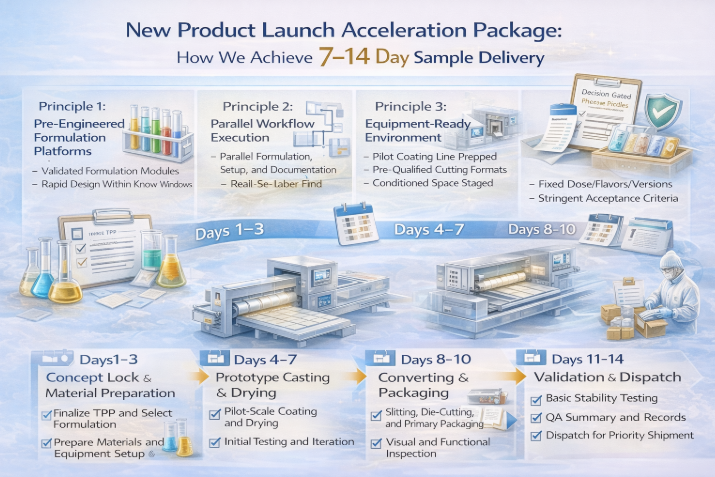
Principle 1: Pre-Engineered Formulation Platforms
Rather than starting from a blank slate, the acceleration package relies on validated formulation platforms:
Polymer systems with known process windows
Plasticizer ranges with predictable mechanical outcomes
Standard excipient libraries
This reduces formulation design time from weeks to days [5].
Principle 2: Parallel Workflow Execution
Traditional OEM workflows are sequential: formulation → process → packaging → documentation. In the acceleration package, these streams run in parallel:
Formulation screening begins while packaging feasibility is assessed
Equipment setup proceeds while raw materials are prepared
Documentation templates are populated concurrently
Parallelization is the single largest contributor to time compression [6].
Principle 3: Equipment-Ready Environment
Sampling delays often stem from equipment conflicts or reconfiguration time. The acceleration package reserves:
Dedicated pilot coating and drying capacity
Pre-qualified cutting formats
Standard environmental conditions
This avoids queueing delays common in shared facilities [7].
Principle 4: Decision-Gated Scope Control
Rapid delivery is protected by strict scope definition:
Fixed dose range
Limited flavor and packaging variants
Clearly defined acceptance criteria
Change requests are logged but deferred until after sample delivery, preventing scope creep [8].
Timeline Architecture: Achieving 7–14 Days
Days 1–3: Concept Lock and Material Preparation
Finalize Target Product Profile
Select formulation platform
Prepare raw materials and equipment setup
Days 4–7: Prototype Casting and Drying
Pilot-scale coating and drying
Initial mechanical and disintegration checks
Rapid internal iteration if required
Days 8–10: Converting and Packaging
Slitting and die-cutting
Primary packaging preparation
Visual and functional inspection
Days 11–14: Validation and Dispatch
Basic stability screening
Documentation summary
Sample release and shipment
This structure assumes no fundamental feasibility barriers [9].
Measures
Acceleration performance is evaluated using the following indicators [10,11]:
Calendar days from concept lock to shipment
Number of internal reformulation loops
Sample pass rate at first attempt
Downstream pilot-scale success of sampled formulation
Customer feedback on sample-to-production consistency
These measures ensure speed does not undermine long-term viability.
Results
Implementation of the acceleration package consistently reduces sampling timelines to 7–14 days while maintaining scale relevance. Projects following this model demonstrate higher conversion rates from sample to pilot production compared with ad hoc rapid sampling approaches. Importantly, overall project duration to commercialization is shortened, not extended, by early discipline [12].
Discussion
Rapid sampling is often misunderstood as a tactical advantage. In reality, it is a systems outcome enabled by prior investment in formulation knowledge, equipment readiness, and workflow design. Without these foundations, speed is achieved only by borrowing risk from later stages.
For brands, evaluating an OEM’s acceleration capability should focus on how speed is achieved, not just whether it is claimed [13].
Conclusion
A 7–14 day sample delivery timeline is achievable in ODF projects without sacrificing scalability—provided acceleration is built on structured platforms, parallel execution, equipment readiness, and disciplined scope control. The New Product Launch Acceleration Package transforms sampling from an improvisational activity into a predictable, repeatable system, enabling faster market entry with lower overall project risk.
References
Cooper RG. Winning at New Products. Basic Books; 2019.
Fu Y et al. Expert Opin Drug Deliv. 2004;1(4):673–690.
Hopp WJ, Spearman ML. Factory Physics. McGraw-Hill; 2011.
Preis M. J Pharm Pharmacol. 2013;65(2):157–170.
Cilurzo F et al. Eur J Pharm Biopharm. 2008;70(3):895–900.
Dixit RP, Puthli SP. J Control Release. 2009;139(2):94–107.
Hoffmann EM et al. Pharm Res. 2011;28(8):1914–1922.
Cooper RG, Sommer AF. J Prod Innov Manag. 2016;33(5):587–610.
Borges AF et al. Int J Pharm. 2015;494(1):332–339.
USP <701> Disintegration Test.
USP <905> Uniformity of Dosage Units.
Keshari R, Keshari S. J Drug Deliv Ther. 2014;4(4):1–7.
Preis M. Drug Dev Ind Pharm. 2013;39(7):1049–1057.