Turnkey ODF Lines Done Right: Layouts, Utilities, Cleanroom Integration
Author: Sihan Meng,Leyu Zhu,Pengcheng Shi
Affiliation: RSBM
Email: pengchengshi@biotechrs.com; pcspc9@gmail.com
Abstract
Turnkey oral dissolving film (ODF) factories succeed when line layout, utility engineering, and cleanroom integration are co-designed around CPP→CQA targets. We present a practical blueprint covering room adjacencies, air handling, pressure cascades, and utility sizing—mapped to release-critical attributes (thickness CV%, assay RSD%, residual moisture, seal/opening force, pouch reject ppm). Three figures illustrate (i) a compact layout, (ii) utility loads by subsystem, and (iii) a pressure cascade. The framework helps owners align equipment, facilities, and GMP workflows for faster start-up and audit-ready operation. [1–9]
Introduction
A high-performing ODF site is more than a coating line: it is a material, air, and data system. Poor room adjacencies or undersized utilities manifest as curl, blocking, web breaks, and pouch rejects. Conversely, balanced drying/conditioning, robust HVAC, and validated air/people/material flows stabilize residual moisture and opening force, lifting yield. This paper provides a turnkey checklist that ties facility decisions to product CQAs. [2–6]
Methods
Process mapping to rooms. Split the flow into Mix & Hold → Coating/Drying → Conditioning/Slitting → Vision QA → Sachet FFS/Cartoning, with airlocks for people/material and unidirectional flow. [2–5]
Utility modeling. Build a subsystem model for power (kW), compressed air (Nm³/h), chilled water (kW-eq), and exhaust/solvent air (Nm³/h); add N+1 margins on critical services. [1,6–7]
HVAC & cleanroom design. Define ISO class targets per room function; set a pressure cascade (e.g., coat/dry highest), adequate ACH/face velocity, and humidity setpoints that support coating and packaging stability. [3–6,8–9]
CPP→CQA linkage. Tie zone ΔT/face velocity, exit moisture, conditioning RH/time, tension, seal T/P/dwell to CQAs and set control/monitoring plans (PAT + historian). [4–6,8]
Measures
Facility/HVAC: differential pressure (Pa), ACH, RH (%), room temps (°C), filter DOP/PAO integrity, particle counts.
Utilities: kW (line & AHU), Nm³/h (air/exhaust), kW-eq (chilled water), uptime (%), redundancy tests.
Process/quality: thickness CV%, cross-web P–V (µm), assay RSD%, residual moisture (%), curl (mm), seal strength/opening force (N), reject ppm. [3–9]
Results
1) Layout that supports flow & cleaning
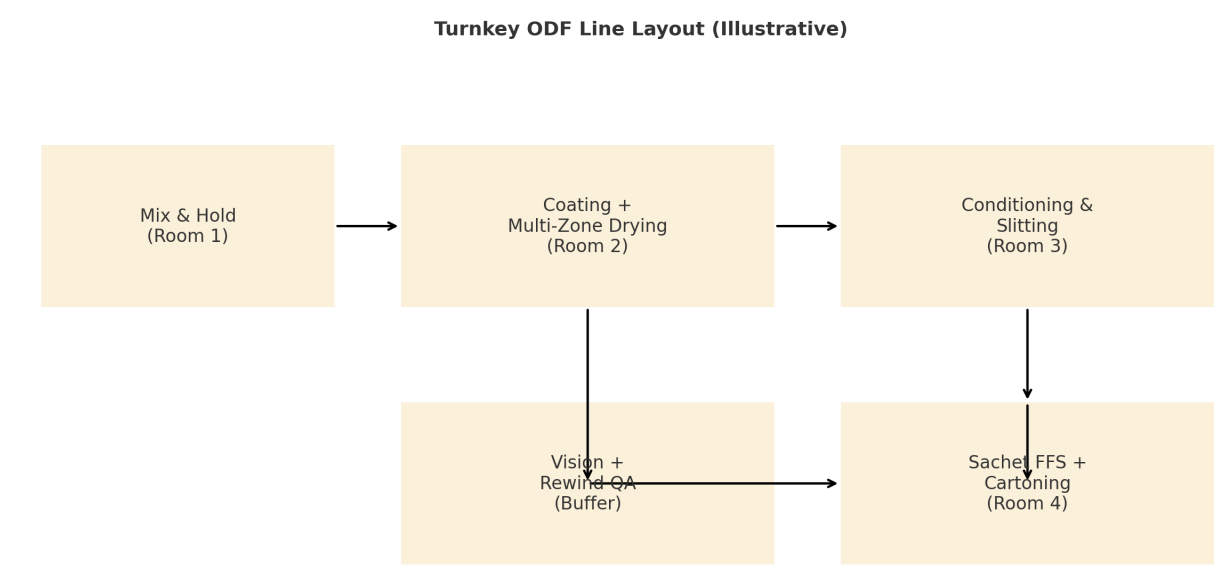
Figure 1 shows an adjacent-room layout: Mix & Hold (Room 1) feeds Coating + Multi-Zone Drying (Room 2); web proceeds to Conditioning & Slitting (Room 3), with a Vision QA buffer, then to Sachet FFS + Cartoning (Room 4). Straight web paths lower tension spikes and scrap; material/personnel move via airlocks to protect pressure gradients. [2–6]
2) Where the utilities go
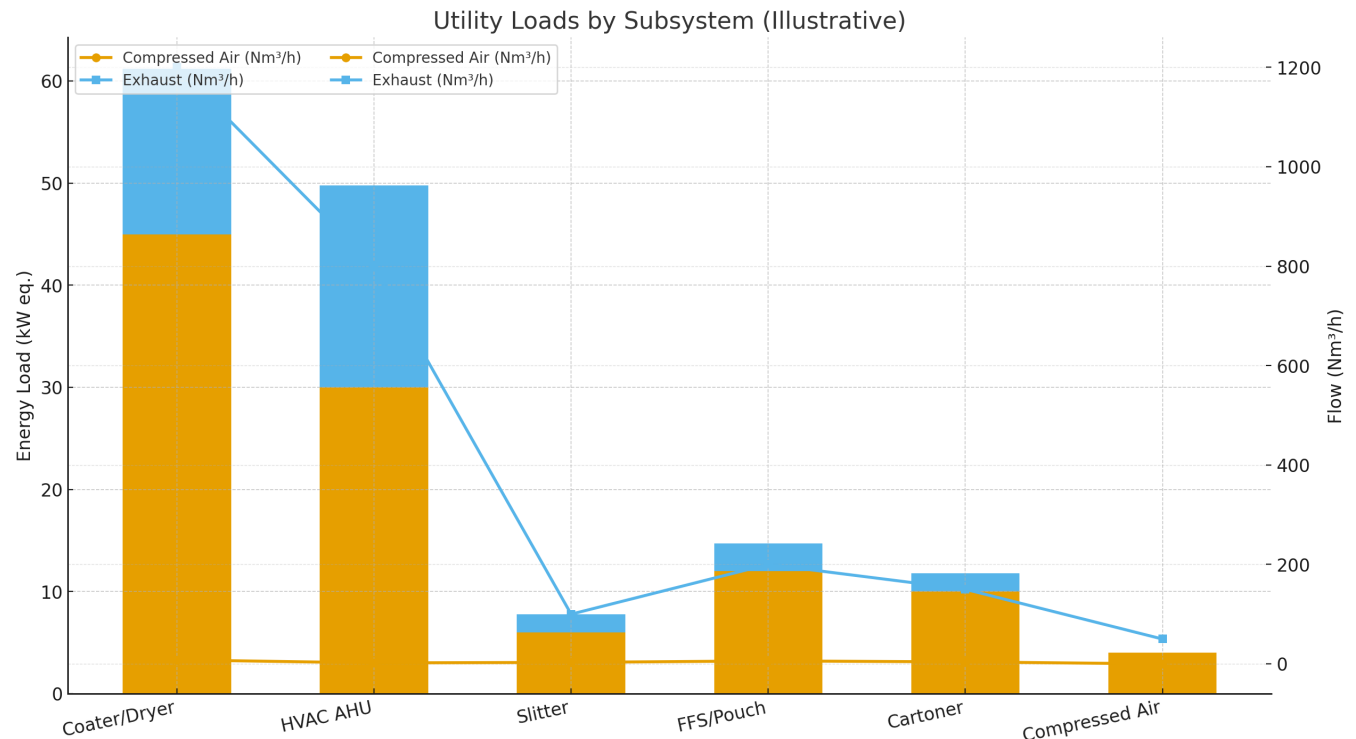
Figure 2 aggregates energy and flows: the coater/dryer and AHU dominate kW; exhaust is driven by drying and AHU; compressed air peaks at FFS and coater utilities. This informs MCC sizing, chiller tonnage, compressor hp, and solvent exhaust capacity. [1,6–7]
3) Pressure cascade that stabilizes moisture and defects
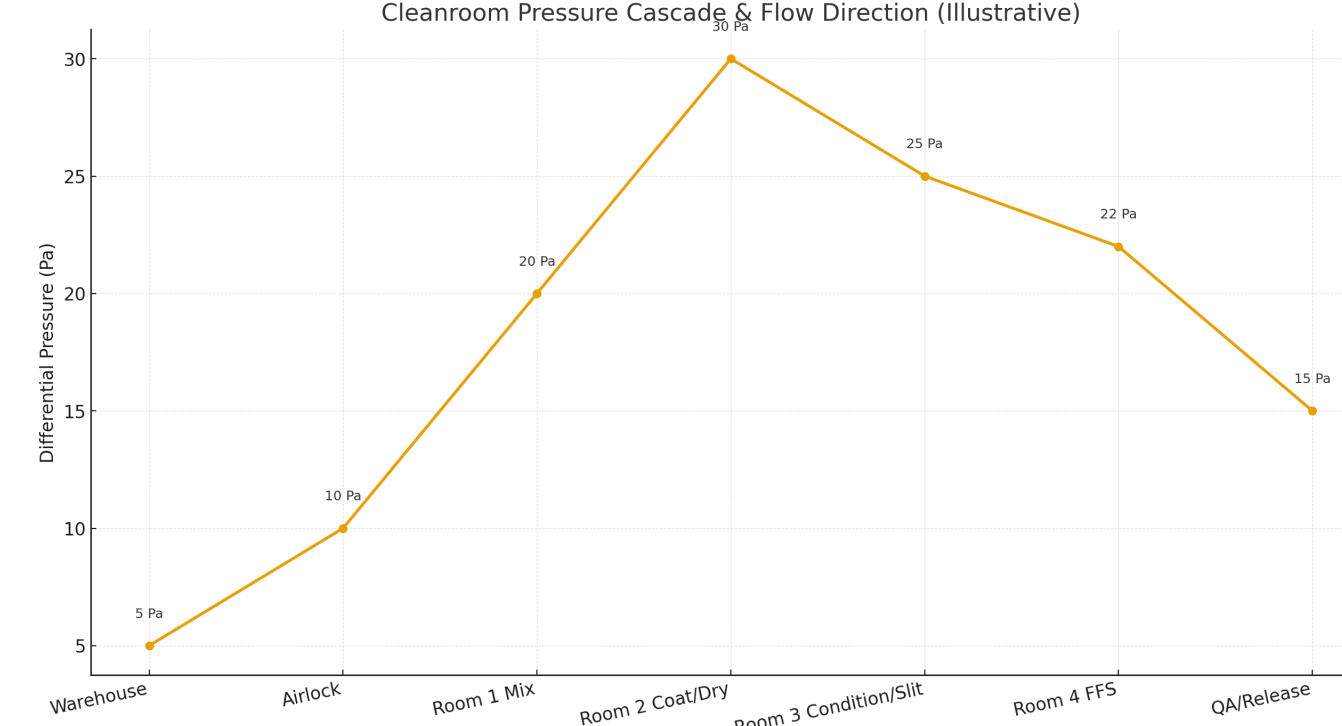
Figure 3 depicts an example cascade (Pa): Coat/Dry (≈30 Pa) > Condition/Slit (≈25 Pa) > FFS (≈22 Pa) > Mix (≈20 Pa) > Airlocks/Warehouse. This suppresses inward leakage, protects wet zones from contaminants, and helps hold residual-moisture windows pre-packaging—reducing curl and blocking. [3–6,8–9]
Discussion
Design rules that pay off
Dose via solids%, not wet gap. Higher solids reduce leveling time and dryer load; pair with balanced ΔT/face velocity to avoid skin-over and edge stress. [2–5]
Condition before slitting. Target RH 45–55% and exit-moisture windows to keep opening force and curl in spec downstream. [3–6]
Short, straight web runs. Fewer turns mean less tension noise and edge cracks; align with EBR + lip-shim tuning for flat cross-web thickness. [2–5]
HVAC first, packaging second. The pouch seal window depends on film moisture; co-engineer laminate OTR/WVTR and room RH to stabilize usability and flavor. [5,8–9]
Instrument, then speed. PAT for thickness/moisture/vision, historian with ALCOA+, and SPC/EWMA alarms must precede rate increases. [4–6,8]
Utilities with headroom. Provide N+1 for compressors/chillers feeding critical coats and forming dies; shock-test ATS/UPS for a safe stop and restart.
Common pitfalls
Coater in too-tight rooms (poor maintenance access, airflow shadows) → streaks, skin-over.
Undersized exhaust or heat recovery → RH creep, sticky films, blocking in stacks.
Ignoring door swings/traffic patterns → pressure reversals, contamination alarms.
Late packaging selection → opening-force drift, pouch leaks.
Conclusion
Turnkey ODF success comes from co-designing layout, utilities, and cleanroom controls around CPP→CQA goals. Plants that stabilize drying/conditioning, size utilities with margin, and maintain a disciplined pressure cascade achieve lower scrap, fewer pouch rejects, and audit-ready performance from day one.
References
Facility and utility capacity planning for continuous and batch processes.
Slot-die coating & web handling for thin films: solids%, distribution, and EBR/shims.
Multi-zone drying: ΔT, face velocity, residence; moisture uniformity and curl.
QbD/PAT: inline thickness, moisture, and vision; historian/ALCOA+; SPC/EWMA.
Conditioning and packaging integration: residual moisture, seal window, laminate OTR/WVTR.
Cleanroom fundamentals: pressure cascades, ACH, filtration, and airlocks.
Electrical/chilled/air/exhaust load estimation and redundancy (N+1) strategies.
Data integrity and computerized systems in pharma/food GMP facilities.
Risk-based commissioning & qualification (URS→DQ→IQ/OQ/PQ) for equipment and HVAC.