Taste-Masking That Works: The Best-Solution Approach to Palatable ODFs
Author: Sihan Meng,Leyu Zhu,Pengcheng Shi
Affiliation: RSBM
Email: pengchengshi@biotechrs.com; pcspc9@gmail.com
Abstract
Taste is the strongest predictor of adherence for oral dissolving films (ODFs). Instead of “single-trick” masking, we implement a Best-Solution approach: start from the API’s bitterness chemistry and dose load, deploy the lowest-complexity tools that meet targets, and escalate only as needed—while keeping rapid disintegration, uniformity, and pouchability intact. Three figures illustrate (i) a decision tree from API assessment to packaging and sensory QA, (ii) time–intensity curves showing progressive reduction of peak bitterness and area-under-bitterness (AUB) as strategies are stacked, and (iii) sensory acceptance vs inherent API bitterness after optimization. Results demonstrate consistent gains in liking without compromising film performance. [1–9]
Introduction
ODFs place actives directly in saliva, where bitterness and astringency are perceived within seconds. Many vitamins, botanicals, and alkaloids are intrinsically unpleasant, creating a three-way tension among palatability, fast disintegration, and dose uniformity. The Best-Solution approach combines modular taste-masking strategies with QbD/PAT so that masking never breaks coatability, leveling, moisture control, or packaging sealability. [2–6]
Methods
Best-Solution decision path.
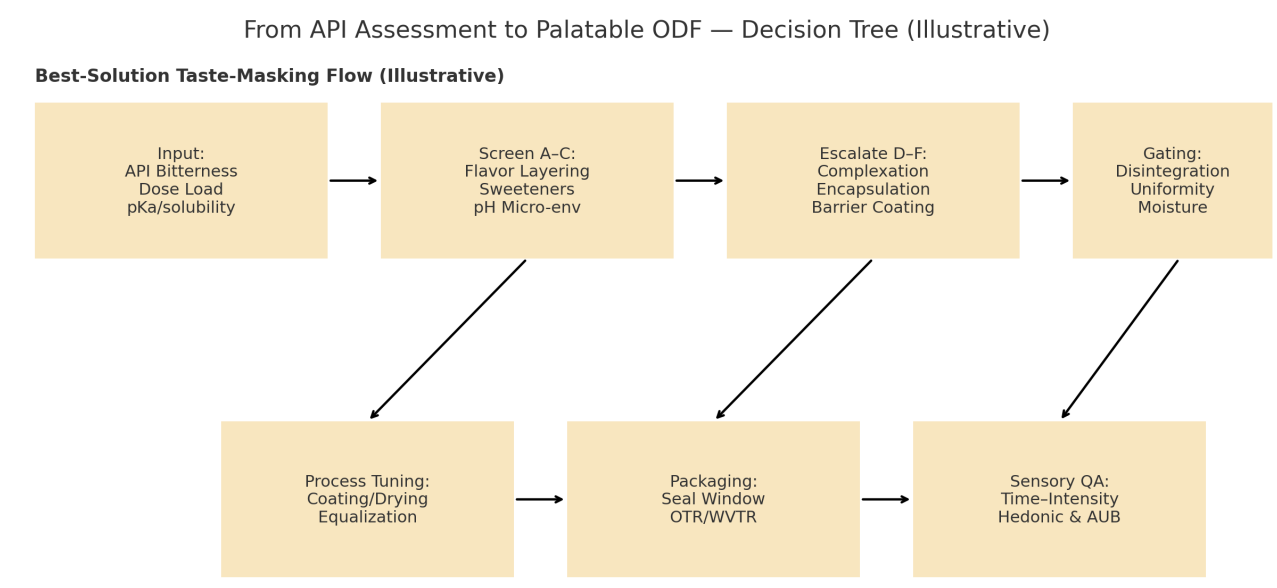
Assess API bitterness (0–10), pKa/solubility, dose load, and off-note descriptors.
Start with low-complexity: A) flavor layering, B) sweetener timing, C) pH micro-environment.
Escalate selectively: D) complexation/ion-pairing, E) lipid/microparticle encapsulation, F) barrier micro-coatings.
Stabilize perception: G) salivary modulators (cooling/tingling) when appropriate.
Gate each step with disintegration, uniformity, residual moisture, and sealability. [3–5,7–8]
CPP→CQA linkage. CPPs: solids %, viscosity law, coat weight, zone ΔT/airflow, exit moisture, conditioning RH/time, seal T/P/dwell, laminate OTR/WVTR. CQAs: disintegration (s), thickness CV%, content uniformity (RSD%), peak bitterness, AUB₁₂₀s, seal/opening force. [4–6,8–9]
Sensory protocol. Randomized, blinded time–intensity to 120 s; hedonic 9-point; triangle tests for detectability; acceptance defined as % panelists rating ≥6/9. [1,6–7]
Compatibility & stability. DSC/FTIR for complexation; particle sizing for encapsulates; accelerated/real-time flavor-hold in validated pouches. [5,8–9]
Measures
Sensory: peak bitterness (0–10), AUB₁₂₀s, aftertaste persistence (s), liking (9-pt), acceptance ≥6/9 (%).
Film/pack: disintegration (s), thickness CV%, residual moisture (%), curl (mm), seal strength (N/15 mm), opening force (N), pouch reject ppm.
Chemistry/structure: complexation ratio, encapsulation efficiency (%), micro-coating thickness (µm). [4–9]
Results
Decision pathway that protects speed and quality
Figure 1 shows a left-to-right escalation from A–C to D–F, with process tuning, packaging, and sensory QA as parallel gates. This prevents late surprises (e.g., great taste but blocked pouches or slow disintegration). [3–6,8]
Strategy stacking reduces peak and AUB
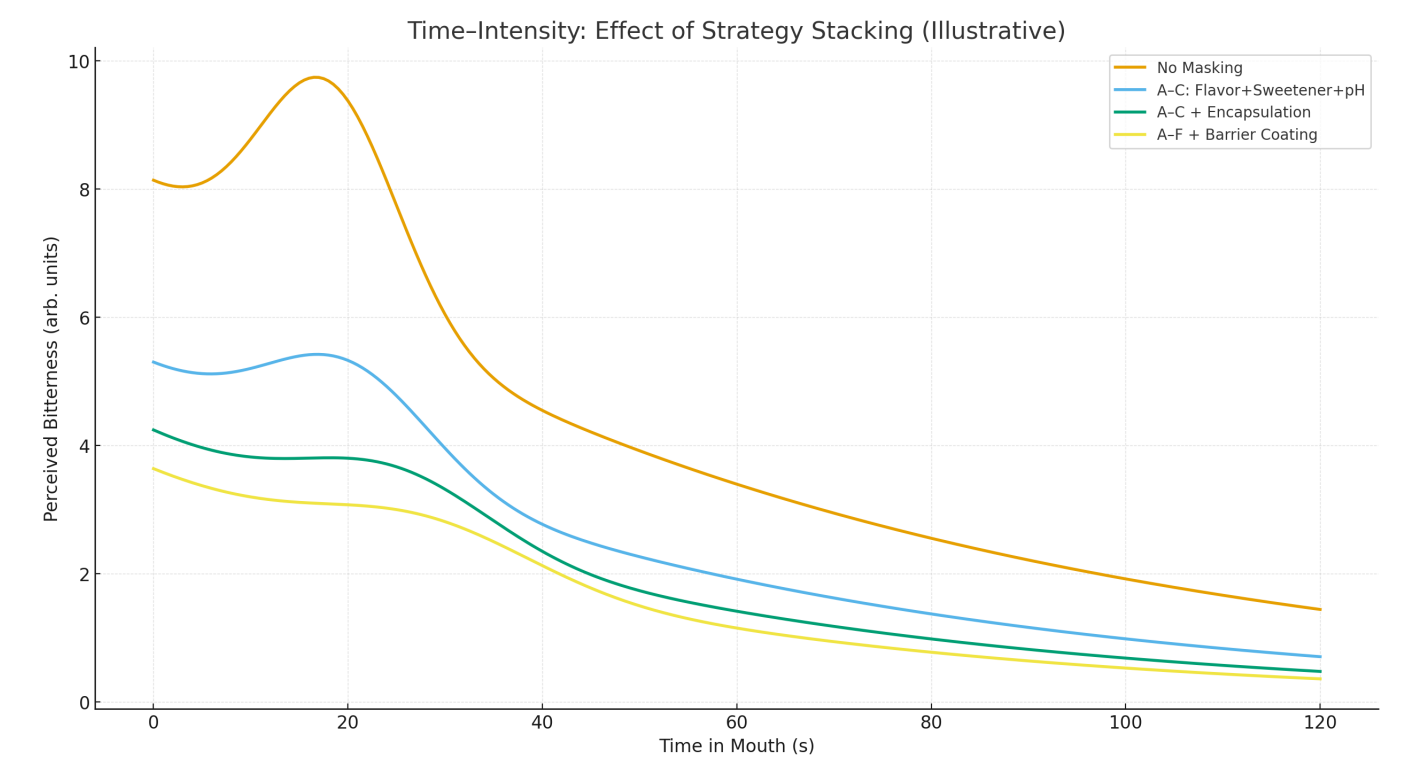
Figure 2 demonstrates a stepwise decrease in peak bitterness and AUB₁₂₀s from A–C to A–F, with the largest additional gain when encapsulation (E) or barrier micro-coating (F) is added—without elongating disintegration. [6–8]
Acceptance vs inherent API bitterness
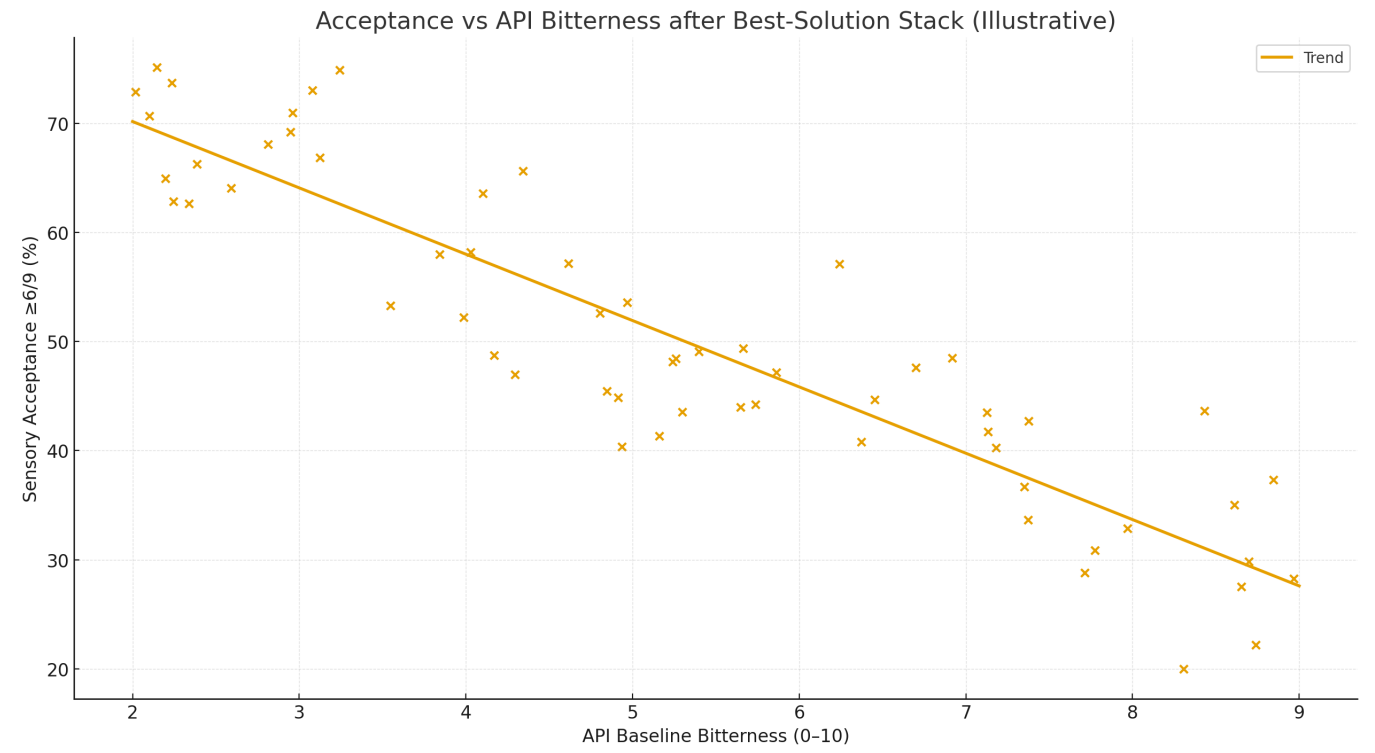
Figure 3 plots post-optimization acceptance against baseline API bitterness. Even very bitter actives can reach ≥60–75% acceptance with a full Best-Solution stack; lightly bitter actives often exceed 85–90%. [6–7]
Discussion
Design rules that make masking “stick”
Tune the viscosity law, not just a single viscosity value. Shear-thinning aids coatability at speed while maintaining rest stability; this preserves leveling despite flavor systems. [4–6]
Prefer solids% increases over thicker wet coats to hit dose without exploding (t_{\text{level}}) and curl. [4–5]
Stage the dryer (ΔT + face velocity) to avoid skin-over that traps surfactants/aromas and causes mottling. [4–5]
Validate packaging early. Seal-window and laminate OTR/WVTR must match residual moisture to prevent flavor loss or over-hard films. [8–9]
When to escalate beyond A–C
Alkaloids/botanicals with high bitterness or lingering astringency → D/E/F.
High dose loads where A–C cannot keep peak below target → E/F to delay release beyond the taste window.
Label constraints (low sugar, “natural”) → adjust B and favor A + C + E with compatible excipients. [3,5,7]
Conclusion
A Best-Solution taste-masking workflow—escalating from simple to sophisticated while gating on disintegration, uniformity, moisture, and pouchability—consistently delivers palatable ODFs. By coupling QbD/PAT with modular masking tools, brands achieve higher first-dose acceptance and sustained adherence without sacrificing manufacturing robustness.
References
Sensory science for oral dosage forms: time–intensity, triangle testing, and acceptance metrics.
Polymer matrices for ODFs (HPMC/PVA/pullulan): rheology, leveling, and mechanics.
Flavor science: layering, congruence, and pH micro-environment strategies for bitterness suppression.
QbD/PAT in thin-film coating: inline thickness/moisture/vision, ΔT/airflow design, historian/ALCOA+.
Wet thickness vs solids% and the impact on leveling, curl, and blocking.
Study designs for taste-masking evaluation: peak, AUB, persistence, and hedonic shifts.
Complexation/encapsulation/barrier micro-coatings for advanced masking.
Packaging validation: seal-window, opening-force windows, and laminate OTR/WVTR selection.
Stability and flavor-hold under accelerated/real-time conditions in pouch formats.