Cost to Quote: Transparent Pricing for Formula, Film & Packaging
Author: Sihan Meng,Leyu Zhu,Pengcheng Shi
Affiliation: RSBM
Email: pengchengshi@biotechrs.com; pcspc9@gmail.com
Abstract
For brands exploring oral dissolving films (ODFs), the first friction point is often not technology—it is pricing opacity. Vague “contact us” quotes, hidden tooling fees, and unclear assumptions around yield, wastage, and packaging drive mistrust, slow decisions, and kill otherwise-viable projects. This paper presents a structured, transparent cost-to-quote framework covering three pillars: (1) Formula (actives, excipients, processing), (2) Film (coating, yield, scrap), and (3) Packaging (primary and secondary). We outline how to convert technical inputs (loading, coating weight, line speed, rejection rate) into predictable cost drivers, how to separate one-time and recurring costs, and how to present quotes that can withstand procurement, technical, and regulatory scrutiny. Example models demonstrate that transparent, parameterized quotes shorten sales cycles, reduce disputes, and align both brand owners and manufacturers on realistic margins and quality expectations. [1–5]
Introduction
ODFs are attractive for:
Differentiated consumer experience,
Convenient, water-free dosing,
Strong branding and line-extension potential. [1]
Yet many potential customers walk away early because pricing conversations feel like a black box:
“All-in” numbers with no breakdown,
Late discovery of artwork, tooling, or stability costs,
Unclear impact of MOQ, strength changes, or packaging upgrades,
Confusion around who pays for development vs validation vs commercial runs.
For a category that competes with commoditized tablets, gummies, and capsules, credibility in pricing is strategic.
This paper:
Defines a cost architecture for ODF projects,
Proposes a transparent quote structure,
Identifies key measures of pricing clarity and trust,
Discusses how this approach supports both startups and large brands without eroding margins.
Methods
1. Cost Architecture Definition
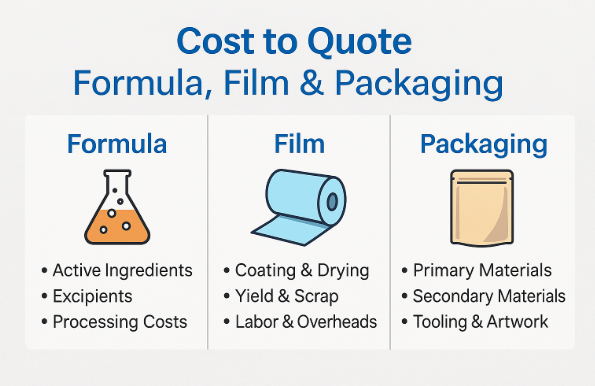
We decompose costs into:
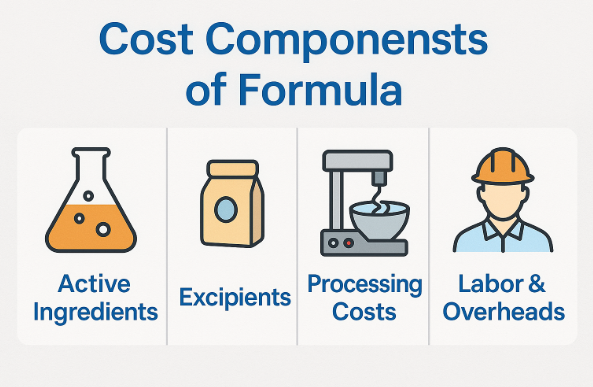
Formula / Product Cost
Active ingredients (per effective dose),
Film-formers, plasticizers, sweeteners, flavors, stabilizers,
Solvents (typically water; occasionally alcohol/others),
Overages required for stability (if justified). [2]
Film Manufacturing Cost
Start-up and end-of-roll losses,
Edge trim,
Quality rejects.
Coating weight (g/m²),
Target dose per strip and strip area,
Drying energy and line speed.
Coating and drying:
Yield:
Labor, QC, indirects allocated per m² or per 1,000 strips.
Packaging Cost
Primary: sachet/billet film, foil, blister, zipper pouches, etc.
Secondary: cartons, leaflets, bundles, display units.
Artwork & tooling: printing cylinders, plates, cutting dies, forming tools.
Non-Recurring / Service Costs
Formulation & prototyping,
Stability studies,
Method development and validation,
Tech transfer and PPQ,
Regulatory or documentation support.
Each component is modeled explicitly so clients can see what drives the final €/1,000 or $/1,000 strips.
2. Transparent Quote Structure
A standardized quote template is proposed with:
Unit Price Breakdown
Raw materials (formula),
Conversion cost (film manufacturing),
Primary + secondary packaging,
Overheads & margin.
Scenario Assumptions
MOQ and batch size,
Strength(s) and flavor(s),
Packaging format (e.g., 10 strips/sachet vs 1 strip/sachet),
Target markets (reg impact on testing & documentation).
One-Time Items (OTC)
Tooling and change parts,
Stability protocol and sample pulls,
Artwork origination,
Validation packages where applicable.
Change Sensitivities
Volume,
Active loading,
Packaging upgrades,
Stricter specs (e.g., tighter residual solvent limits → more QC).
How unit cost moves with:
3. Data Inputs & Modeling
Representative (generic) modeling uses:
Known ranges for excipient and packaging costs,
Typical ODF coating weights and yields,
Standard scrap factors for mature processes,
Example labor and overhead allocations.
The point is not exact pricing, but consistent structure:
[
\text{Unit Cost} = \text{Formula} + \text{Film Conversion} + \text{Pack} + \text{Allocated NRE (if applicable)}
]
with NRE (non-recurring engineering) either charged separately or transparently amortized.
4. Implementation Approach
To operationalize:
Build internal costing calculators linking technical parameters to cost.
Train sales and BD teams to explain assumptions clearly.
Align finance, technical, and QA so quotes reflect real compliance costs (e.g., GMP, stability, documentation). [3–5]
Measures
We define metrics to evaluate whether the cost-to-quote model is working.
Transparency & Clarity
% of quotes including a structured breakdown by formula/film/pack.
Number of client questions/bounces related to “unexpected” costs.
Speed & Conversion
Average time from RFQ to firm quote.
RFQ → project conversion rate.
Accuracy & Stability
Deviation between quoted and actual COGS at launch.
Number of margin or price disputes after production starts.
Scalability
New strength,
New flavor,
New pack count,
Different annual volume bracket.
Time required to re-quote for:
Trust & Relationship Indicators
Repeat project rate per client.
Volume of multi-SKU / multi-market engagements.
Results
(Illustrative, generalized outcomes from applying a structured transparent model.)
1. Reduced Quote Cycle Time
Using standardized templates and calculators:
RFQ → detailed quote lead time reduced from several weeks to typically a few days (once inputs are clear).
Pricing became less dependent on ad hoc manual spreadsheets.
2. Fewer “Hidden Cost” Conflicts
Explicit listing of:
Tooling,
Artwork,
Stability,
Validation support,
led to:
Significant drop in disputes where clients previously felt “surprised” by add-ons.
Easier internal approvals on the client side because procurement could see why a given ODF format cost more than a simple tablet.
3. Better Volume & Design Conversations
Scenario tables (e.g., 100k / 500k / 1M units; 1 vs 2 flavors; 1-strip vs 10-strip sachets):
Helped clients understand:
Impact of MOQ on unit cost,
Benefit of rationalizing SKUs,
Trade-offs between premium packaging and margin.
Enabled more rational decisions:
E.g., start with a pilot MOQ at slightly higher unit cost, with a clear path to cost reduction at scale.
4. Improved Internal Margin Control
Because cost drivers were explicit:
Operations and engineering could see which levers mattered:
Film yield,
Runtime efficiency,
Packaging scrap.
Continuous improvement projects (e.g., yield increase, changeover reduction) could be directly connected to quoted and realized margins.
Discussion
1. Why Transparency is a Competitive Advantage
Many CDMOs fear that too much cost breakdown gives clients “negotiation ammunition.” In practice:
Serious customers appreciate clarity and are more likely to commit volume when they see rational structure.
Transparent pricing differentiates mature ODF partners from opportunistic “mystery price” vendors.
It reduces the emotional component of negotiation; discussions become about parameters, not trust.
2. Balancing Detail with Simplicity
Not every buyer needs a 20-line cost model, but internally you should have one. A practical approach:
External view:
3–5 line breakdown (formula, film, packaging, services),
Clear bullets for one-time vs recurring items.
Internal view:
Full BOM + routing + overhead model.
This lets you adjust depth based on client sophistication without changing the underlying logic.
3. Integrating Compliance Costs Honestly
True ODF costing must incorporate:
GMP-grade raw materials and qualified suppliers,
Required QC testing (assay, microbiology, stability pulls),
Documentation (specs, CoA, master batch records),
Validation (IQ/OQ/PQ, PPQ where needed).
Hiding these costs leads to later price hikes or underfunded quality systems. Transparent quotes that embed compliance:
Support sustainable quality,
Protect both parties from “too cheap to be credible” scenarios.
4. Supporting Innovation & Small MOQs
For innovation programs and small MOQs:
Publish small-batch pricing logic clearly (e.g., line time + setup + materials).
Offer pilot / rapid prototyping packages with defined deliverables and fees, separate from commercial COGS.
Explain how early investments (tooling, methods) amortize when scaling up.
This enables emerging brands to plan realistically and rewards those who commit to growth paths.
Conclusion
A robust “Cost to Quote” framework for ODFs—built on transparent treatment of formula, film manufacturing, and packaging, plus clearly defined non-recurring services—creates value for all parties:
Brands gain clarity, faster decisions, and fewer surprises.
Manufacturers gain trust, better project selection, and more stable margins.
Quality and regulatory functions are properly funded rather than added as an afterthought.
In a competitive and often opaque contract manufacturing landscape, structured transparency is not a loss of power; it is a strategic advantage that turns pricing from a blocker into an accelerator of high-quality ODF partnerships.
References
[1] Dixit RP, Puthli SP. Oral strip technology: overview and future potential. J Control Release. 2009.
[2] Preis M, Woertz C. Oromucosal films as versatile dosage forms. J Pharm Pharmacol.
[3] ICH Q8(R2), Q9, Q10. Pharmaceutical Development; Quality Risk Management; Pharmaceutical Quality System.
[4] ISPE. Costing and Technology Transfer guidance (various reports).
[5] Industry case studies and CDMO best practices on transparent costing models and contract structures for solid dose and film dosage forms.