30 Days to Launch an ODF Product: A 0→1 Minimum Viable Formulation & Manufacturing Plan (MVP Guide)
What this MVP guide gives you
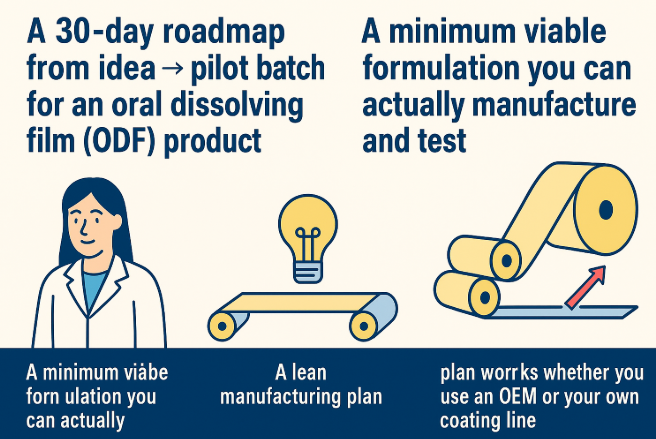
A 30-day roadmap from idea → pilot batch for an oral dissolving film (ODF) product
A minimum viable formulation you can actually manufacture and test
A lean manufacturing plan that works whether you use an OEM or your own coating line
1. The uncomfortable truth: why most ODF projects never leave PowerPoint
Before we talk about “30 days”, here’s what usually happens in the real world:
Formulation R&D and marketing run in parallel but not aligned → dose, taste and strip size keep changing.
Everyone underestimates coating & drying constraints; the “ideal” lab formula can’t run on a real ODF line.
Regulatory, quality, and packaging join too late → the “great formula” sits months waiting on labels and documents.
Result:
You spend 6–9 months and still don’t have a sellable ODF product, only nice slides and a few lab strips.
This guide is built on a different attitude:
We’re not trying to make the “perfect” ODF in 30 days. We’re trying to make a “boringly manufacturable” MVP that can be improved later.
2. 30-Day ODF Roadmap at a Glance
Think in four weekly milestones, not in hundreds of tasks.
Week 1 – Product brief & guardrails
Pick one use-case (e.g. sleep, energy, vitamin, fresh breath).
Fix dose range, strip size, and “must-have” claims.
Decide market type: food supplement / cosmetic / Rx (impacts excipients & paperwork).
Week 2 – Minimum viable formulation (lab scale)
Build 1 base film matrix (polymer + plasticizer + sweetener).
Make 3 variants (e.g. different loadings / flavors) and test disintegration, handling, and taste.
Lock a provisional composition window, not just one exact formula.
Week 3 – Minimum viable manufacturing plan
Decide OEM vs in-house line.
Translate lab formula into coating solids %, target wet thickness, drying window.
Run a small pilot batch on a real or simulated coating line.
Week 4 – Quality, packaging, and “ready to show”
Do basic QC: appearance, weight / area, assay, disintegration, peel / opening test.
Put strips in real packaging with draft design.
Prepare a one-page technical summary for internal / customer validation.
All we’re doing is:
One brief → One matrix → One line capable of running it → One QC baseline → One story.
3. Building the Minimum Viable ODF Formulation (Week 2)
3.1 Define the product in one sentence
“A [X mg] ODF for [function], dissolving in <30 seconds, in a [Y × Z mm] strip, with [flavor] and no [unwanted excipient].”
If you cannot fill this one sentence, you’re not ready for 30 days.
3.2 Choose a simple, manufacturable base matrix
A minimum viable ODF matrix usually needs:
Film-forming polymer – e.g. pullulan, HPMC, PVA (choose 1, maybe 2)
Plasticizer – e.g. glycerol, sorbitol to prevent brittleness
Sweetener – sugar-free if possible (stevia, sucralose, acesulfame K, etc.)
Flavor – 1–2, not a full cocktail
API or active blend – at a dose that is realistically soluble or dispersible in the matrix
For an MVP:
Avoid exotic polymers that your manufacturer has never coated.
Avoid flavor systems that require 8+ components and special handling.
Start with a safe solid content (e.g. 10–20 %) that your OEM line already knows.
3.3 Formulation MVP checklist
Your formulation is “minimum viable” if:
Lab strips can peel cleanly from the casting surface without tearing.
They don’t crack when bent (at least 2–3 folds).
Disintegration in 37 °C water is ≤ 30–60 seconds for your category.
Taste is “acceptable +”, not perfect (you can refine after launch).
If you fail any of these, you don’t have an MVP—just a lab curiosity.
4. Designing the Minimum Viable Manufacturing Plan (Week 3)
You can’t launch an ODF product if no real line can run it.
4.1 OEM vs in-house ODF coating line
OEM route (recommended for MVP)
Use an existing ODF manufacturer with a running coating/drying/packaging line.
Your goal in 30 days is to fit your formula into their process window, not redesign their plant.
In-house route
Only realistic if you already have slot-die or comma coater, multi-zone drying, slitting and packaging.
The MVP mindset still applies: one speed, one thickness, one stable window.
4.2 Translate lab formula into line parameters
Your OEM or process engineer will care about:
Solids content (%) → viscosity / coatability
Target wet thickness (μm) → dry film thickness (e.g. 80–120 μm)
Drying profile – zone temperatures, air flow
Line speed that ensures complete drying without skin-layer defects
For an MVP run, aim for:
One conservative line speed that gives defect-free film, not max throughput
Cross-web thickness deviation ≤ ± 8 μm
Clean release and no blocking when winding / unwinding
4.3 “Good enough” MVP QC set
For a 30-day launch, your minimum test panel should include:
Appearance – no holes, major streaks or delamination
Strip weight or thickness per area – basic uniformity
Assay / content uniformity – especially for actives
Disintegration time – lab benchmark and in-mouth feedback
Mechanical handling – peel strength, resistance to cracking
Packaging openability – bag / blister can be opened in 1–2 seconds
You’re not writing a full PhD thesis here; you’re making sure the product is safe, consistent, and usable.
5. 30-Day ODF MVP: Concrete Action Plan
Use this as a day-by-day guideline. It’s not perfect, but it’s realistic.
Days 1–3 – Lock the brief and constraints
Choose one product and say “no” to feature creep.
Fix: target market, dose range, strip size, basic flavor profile.
Align internally: marketing, R&D, QA, and whoever signs off cost.
Days 4–10 – Lab formulation sprint
Prepare 1 base matrix + 3 variants (e.g. flavor / dose / sweetener tweaks).
Run simple tests: appearance, peel, bending, disintegration, taste.
Kill obviously bad variants fast; keep 1–2 that pass the MVP checklist.
Days 11–17 – OEM / line alignment
Share solid content, viscosity range, target thickness with your OEM or plant.
Adjust formula once based on their coating and drying window.
Plan a small pilot batch (e.g. one narrow-web roll).
Days 18–23 – Pilot run & first QC
Produce the pilot on the real line.
Test: thickness, assay, disintegration, appearance, packaging.
Collect simple sensory feedback from a small internal panel.
Days 24–30 – Package, document, and decide
Put strips into real-looking packs (pouch / blister / wallet).
Create a one-page technical summary: formula, key specs, pilot results.
Decide:
Go – move to bigger batch / customer samples / soft launch
Hold – adjust one key parameter and re-run
Kill – stop and re-brief instead of forcing a bad product
6. FAQ – Common Questions About a 30-Day ODF MVP
Q1: Is a 30-day ODF launch realistic, or just a marketing slogan?
A: It is realistic only if you narrow the scope to a single product, use an existing ODF line (OEM or in-house), and agree that this is an MVP, not the final “premium” formulation. You’re proving that the idea is manufacturable and acceptable, not reaching perfection.
Q2: How stable does the MVP need to be before I show it to customers?
A: For a 30-day MVP, you won’t have full 6–12-month data. But you should at least have:
One accelerated condition started (e.g. 40 °C / 75 % RH)
Short-term checks (e.g. 2–4 weeks) showing no critical drift in appearance, disintegration, or peel strength
A plan to keep testing while you’re collecting early market feedback
Q3: What if the OEM can’t run my “ideal” formulation?
A: In MVP mode, the correct question is:
“What formula can your line run reliably in the next 30 days that still meets my basic claims?”
You can always improve flavor, sweetness, or strip thickness later. A slightly less fancy but manufacturable formula is worth more than a perfect lab recipe that never leaves the beaker.
Q4: Should I aim for the fastest dissolving time possible in the MVP?
A: Not necessarily. Ultra-fast films can create handling and packaging problems (too soft, too sticky). For an MVP, target a dissolving time that is:
Clearly faster than tablets or gummies for your category
Easy to manufacture and pack without blocking, peeling, or tearing
You can optimize “3-second wow effect” in a V2 once basic robustness is proven.
7. Final Attitude: Boring Is Beautiful (for MVPs)
The goal of a 30-day ODF MVP is not to win an innovation award.
It is to get one product from the slide deck onto a real strip, in a real wrapper, that:
Dissolves in a reasonable time
Can be made on a real line
Has basic data behind it
Everything beyond that—perfect taste, ultra-fast dissolving, and a full product range—belongs to Version 2.
If you can accept that, 30 days is not a dream; it’s a schedule.