Bitter, Spicy, Fishy Oral Films? This 3-Step Taste-Masking System Brings the Flavor Back
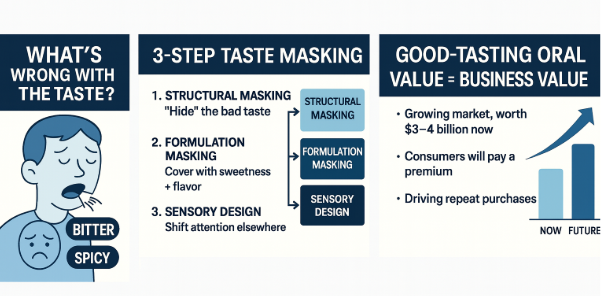
By 2024, the global oral thin film / oral dissolving film (ODF, orodispersible film) market is estimated at around USD 3–4 billion, and most reports expect it to reach USD 7–10 billion by 2030–2035, with a compound annual growth rate (CAGR) of roughly 8%–11%.
Behind this growth are two hard trends: more people hate swallowing pills, and expectations for taste and user experience keep rising.
In this context, any formula that tastes bitter, harsh or fishy at first contact simply cannot become a mainstream product.
Around one small piece of oral dissolving film, you can make money in several ways:
Brand owners
Upgrade melatonin, vitamins, caffeine, breath fresheners, sexual health and pet nutrition into high-experience, high-design oral thin films,
Use “tastes good + looks good + easy to carry” to justify higher pricing and higher margins.
Factory owners / manufacturers
Build high-load + good-taste oral film formulations and production lines,
Offer ODF OEM/ODM services, and the more high-demand brands you can serve, the higher your bargaining power and processing prices.
Foreign trade / intermediaries
Understand how to explain taste-masking systems + process design,
So when clients complain about bad taste, you can offer professional solutions and win long-term formulation and OEM projects, instead of just a one-off price margin.
This article uses five “golden points” to show how to fix bitter, spicy, fishy oral dissolving films with a 3-step taste-masking system, while naturally including SEO keywords such as oral dissolving film, oral thin film, orodispersible film, taste masking, ODF OEM/ODM, etc.
We’ll finish with a practical FAQ.
I. Golden Point 1: First clarify—what exactly makes it “taste bad”?
For oral dissolving films, the most common “taste disasters” fall into three categories:
Bitterness
Typical actives: caffeine, some herbal extracts, certain B-vitamins, bitter small-molecule APIs.
Problem: first 1–2 seconds are okay, but halfway through disintegration a strong “back-end bitterness” appears.
Harsh / spicy / irritating sensation
Typical actives: high-dose menthol, nicotine-type actives, some flavours or organic acids.
Problem: at first contact, the user feels “throat burn, sting, irritation”, and sensitive users give up immediately.
Fishy / medicinal / metallic notes
Typical actives: fish oil, some amino acids, iron and other mineral supplements.
Problem: in swallowable dosage forms people can barely accept it,
in an oral thin film that dissolves in the mouth, the off-notes are amplified.
Core reality:
With oral thin films, taste issues are amplified because:
The film is thin and disintegrates fast, so all flavours explode within a few seconds.
The product must stay in the mouth for a while — the user has nowhere to hide.
Consumers subconsciously expect it to be “like candy”, so the disappointment gap is even larger.
If you want your oral dissolving film to sell and scale, taste masking is the entry ticket.
If this gate is not passed, there will be no repeat purchase, and certainly no chance of reaching tens of millions of films per year in ODF OEM/ODM projects.
II. Golden Point 2: The overall logic of the 3-step taste-masking system
The logic of this 3-step system is simple:
First “hide it” → then “cover it” → finally “distract attention”
In technical language for oral films, that means:
Step 1: Structural masking – hide the bad taste behind a carrier
Step 2: Formulation masking – use sweetness + flavour to cover what remains
Step 3: Sensory design – use “top note–mid note–aftertaste” to shift attention
Let’s unpack these one by one.
III. Golden Point 3: Step 1 – Structural masking: hide the bad taste first
Goal: minimise direct contact between bitterness/harshness/fishiness and the oral mucosa.
Common techniques (where you can naturally insert SEO terms like taste masking, complexation, encapsulation) include:
1. Complexation / inclusion (e.g. cyclodextrins)
Best for:
Small, volatile, strongly flavoured or bitter molecules (e.g. caffeine, some botanical extracts).
Approach:
Use β-cyclodextrin, γ-cyclodextrin or derivatives to form inclusion complexes;
Pre-form the complex in an aqueous system, then incorporate into the ODF solution.
Benefits:
Improves solubility + stability + odour at the same time;
Backed by many precedents in oral dosage forms.
2. Microencapsulation / embedding
Best for:
Strong bitterness, fishy smell, metallic taste and other “nightmare-level” flavor problems.
Approach:
First convert actives into microcapsules or spray-dried powders, then mix into the film-forming solution;
Or use lipid / polysaccharide matrices for simple embedding.
Benefits:
Greatly reduces the direct contact between the active and the oral cavity;
Can be tuned to release mainly in the stomach rather than the mouth.
3. Micro-pH environment adjustment
Some actives’ bitterness and irritation are strongly pH-dependent.
By designing different buffer systems within the film, you can:
Slightly adjust the micro-environmental pH,
So that the “worst” taste does not fully release in the few seconds in the mouth.
The core of this step is to build an “invisible shield” inside the oral thin film.
If you do this well, sweetness and flavour in the next step actually have room to work.
If not, no matter how much sweetener and flavour you add, you’ll be fighting against the base chemistry.
IV. Golden Point 4: Step 2 – Formulation masking: cover the rest with “sweetness + flavour + mouthfeel”
Once structural masking has laid the foundation, formulation comes in to “decorate the house”. Three main levers:
1. Sweetener system
Use sweetener combinations, not just a single one:
High-intensity sweeteners (acesulfame K, sucralose, stevia, etc.) provide sweetness value.
Polyols (xylitol, sorbitol, maltitol, etc.) support mouthfeel fullness and cooling sensation.
Tips:
For strongly bitter actives, you may slightly increase early-phase sweetness to improve the first impression.
Avoid “cloying sweetness” — it feels cheap and can drag the bitterness back into focus.
2. Flavour system
Principle: don’t fight the off-note head-on — go with the flow.
Bitterness: works well with citrus, cola, coffee, caramel, etc.
Harsh/cooling: works well with menthol, eucalyptus, herbal flavours to make “sting” feel deliberate.
Fishiness: works with lemon/lime and light acidic fruit notes to raise the overall “freshness”.
Key point:
Flavour is for harmonising, not just “putting a lid on”.
Overloading flavour simply gives you “cheap artificial flavour + drug taste” instead of a pleasant profile.
3. Mouthfeel and disintegration profile
The ratio of film-forming polymers (HPMC, PVA, pullulan, etc.) affects:
Disintegration time (3 s vs 10 s vs 20 s).
Oral stickiness.
Mechanical strength and flexibility.
For taste masking:
If disintegration is too slow → the user is “forced” to experience bitterness again and again.
If disintegration is too fast → bitterness may explode all at once and overwhelm sweetness and flavour.
In practice, each type of oral dissolving film (e.g. melatonin oral film, caffeine oral strip) should have its own “custom disintegration curve” that matches its taste-masking strategy.
V. Golden Point 5: Step 3 – Sensory design: use “attention shift” to finish the job
Even with good structural and formulation masking, many oral thin films fail on the aftertaste.
This final step is sensory rhythm design:
1. Design a “top–middle–aftertaste” experience
First 1–3 seconds:
Focus on “safety + sweetness + flavour impact” to make the user think, “Oh, this is quite nice.”
3–7 seconds (during disintegration):
Ensure smooth disintegration with no large residues.
Keep flavour and cooling at a stable, comfortable level.
Final 5–10 seconds (after swallowing):
Use a light mint/herbal/fruit note as a lingering aftertaste to cover any residual bitterness or fishiness.
2. Reinforce the “tastes good” label via copy and visuals
Many factories ignore this, but it’s crucial for brands and exporters:
In product pages, packaging and videos, compare the experience to mints or fruit candy.
Help users pre-frame it in their mind as something tasty.
When the technical side reaches a 7 out of 10, and sensory design adds 2–3 more points,
your oral dissolving film goes from “barely acceptable” to “actually tastes nice” in the user’s mind.
That directly drives repeat purchase and word of mouth — and determines whether your ODF OEM/ODM projects can command higher prices.
VI. Practical recommendations for three audiences (factories / brands / traders)
1. Factory owners / technical leads
Turn this 3-step system into your ODF taste-masking SOP:
Structural masking module.
Formulation masking module.
Sensory tuning module.
In external marketing, clearly highlight on your website, Alibaba profile and LinkedIn that you:
“Specialise in bitter API taste masking for oral thin films.”
“Provide taste-masked ODF OEM/ODM solutions.”
2. Brand owners / product managers
For every oral film project, treat taste masking as a separate task, not just one casual sentence “make the taste better”:
First impression,
In-mouth phase,
Aftertaste.
Include a dedicated “taste masking strategy” section in your project brief.
In your sample evaluation sheet, score separately:
When selecting a factory, proactively ask:
“What cases have you done for bitter / pungent / fishy APIs?”
“Can you show me 2–3 successful taste-masking projects?”
3. Foreign trade / intermediaries
Turn this article’s logic into a short PPT for clients:
1 page: why taste is harder for ODF than tablets/capsules.
1 page: 3-step taste-masking system.
1 page: the services you provide (factory selection + sample follow-up + taste optimisation).
Whenever a client complains “taste is bad” or “too bitter”, don’t just say “we’ll ask the factory to improve it”.
Instead, use this 3-step framework to explain:Which step is currently weak.
What exactly will be changed in the next sample.
This is how you position yourself as a solution-driven project manager, not just a message forwarder.
VII. Action checklist you can use immediately
Review your existing oral dissolving film formulas and make a simple table:
Which products have “acceptable entry but terrible aftertaste”.
Which ones are “unpleasant from the first second”.
Which ones users say “taste like a candy”.
Choose 1–2 products with the biggest taste problems and apply this 3-step system once from end to end.
Record before/after feedback and sample comparisons, and build your own taste-masking case library.
On your website, Alibaba listings and social media, add keywords like:
“taste-masked oral thin film”
“bitter API oral film solution”
“ODF OEM/ODM with improved palatability”
For every new oral dissolving film project,
don’t just talk about “dose, price and lead time”.
Proactively add one sentence:“We can also develop a taste-masked version of your oral thin film,
with a flavour profile comparable to candies or mints.”
FAQ: Common questions about taste masking in oral dissolving films
Q1: Is stronger taste masking always better?
Not necessarily. The goal is “pleasant entry and clean aftertaste”.
Over-masking = higher cost + artificial flavour + more complex process.
The key is to find a balance between consumer acceptance and cost.
Q2: Do caffeine oral films always need complexation/encapsulation?
Not always, but for high-dose caffeine, at least one structural masking tool (e.g. cyclodextrin inclusion) is strongly recommended.
Otherwise, in oral thin film form, you often get “okay at first, then sudden bitter spike mid-disintegration.”
Q3: Can oral films with fish oil or complex herbal extracts actually taste good?
Yes, but the difficulty is higher.
Typically you’ll need a combination of encapsulation + citrus flavours + light acidity + mild mint,
plus several rounds of consumer testing to push the product into the “acceptable or even enjoyable” range.
Q4: Will taste masking affect dissolution or bioavailability?
It might, which is why structural masking must be evaluated together with dissolution testing.
Some complexation and encapsulation techniques actually improve solubility.
Others, if poorly chosen, may slow down or reduce release.
Q5: I’m “just” in foreign trade, not a formulator. Do I really need to know all this?
Absolutely.
When clients complain about taste,
most traders can only say, “We’ll ask the factory to improve it.”
You, on the other hand, can say:
“We can optimise your oral thin film with a 3-step taste-masking strategy:
structural masking, sweetener & flavour optimisation, and sensory design.”
That is the starting point of your transformation from a price forwarder to a technically savvy project manager.